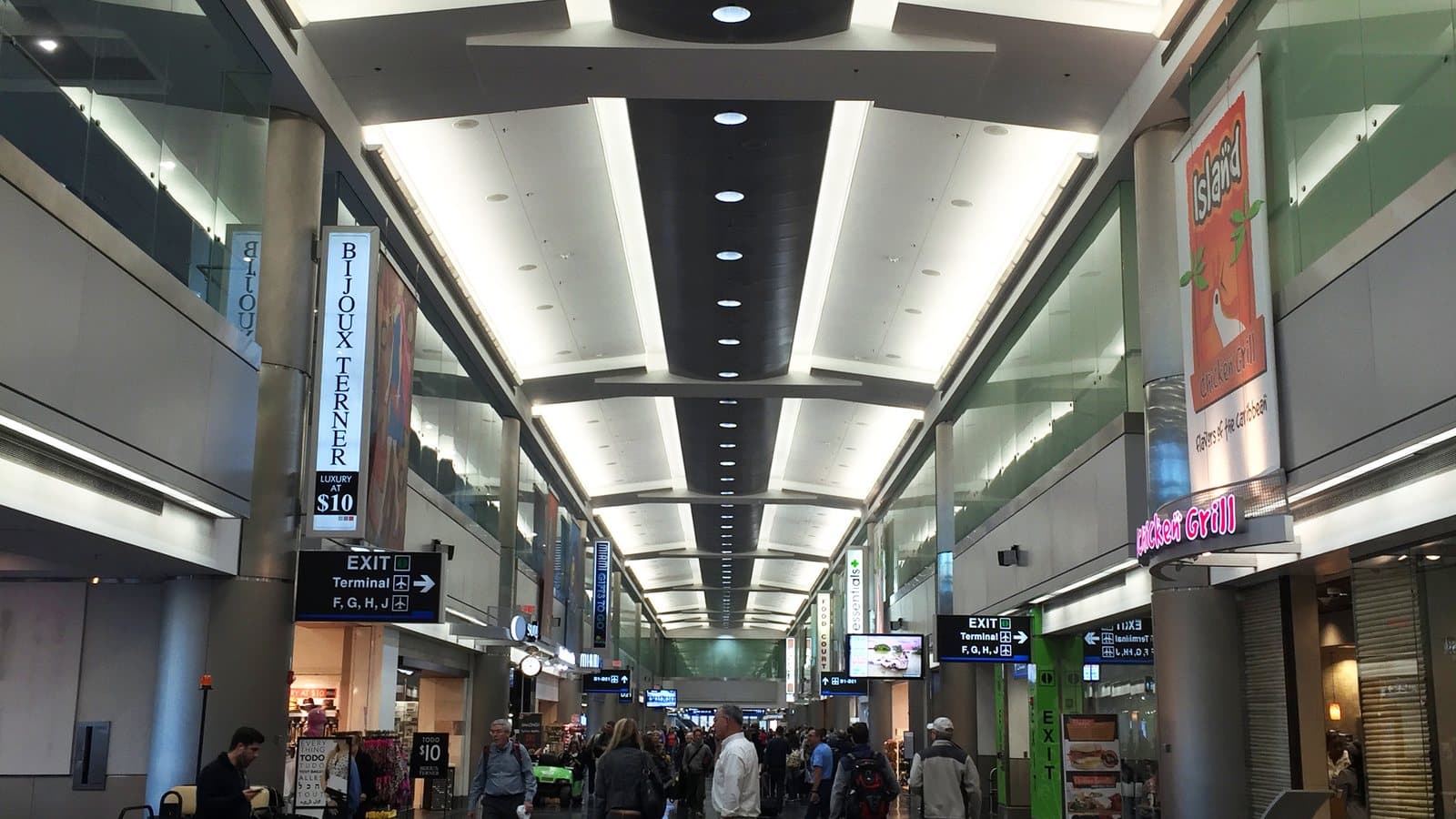
Quick answer: the live board above shows every flight leaving Miami International Airport (MIA). Check-in and bag drop are on Level 2 of each terminal, and which door you walk in depends on your airline: the North Terminal (Blue) is Concourse D, the Central Terminal (Yellow) covers Concourses E, F and G, and the South Terminal (Red) holds H and J. Every concourse screens passengers at its own checkpoint, so arriving at the wrong one costs you a walk, not a minute.
Which terminal do I check in at?
MIA is one U-shaped building split into three terminals and six concourses, lettered D to J. The airline decides which section you use, not the destination.
| Terminal | Concourses | Gates | Who flies from here |
|---|---|---|---|
| North (Blue) | D | 51 | American Airlines, domestic and international |
| Central (Yellow) | E, F, G | E 18 · F 19 · G 14 | American and Oneworld partners, Caribbean and Latin American carriers (E); domestic and Canadian services (F, G) |
| South (Red) | H, J | H 13 · J 15 | Delta and other non-Oneworld airlines (H); long-haul intercontinental routes (J) |
Our airline directory lists the check-in counters and kerbside doors airline by airline, and the terminals guide shows how the concourses fit together. If you prefer a picture, use the airport map.
Flying from Concourse E? Gates E20 to E33 are not in the main concourse at all: they sit in a satellite building, reached from Gates E2 to E11 on Level 4 by the MIA E Train or a pedestrian walkway. The satellite is big enough to take an Airbus A380, and the transfer adds a few minutes to the walk to your gate.
Check-in, bag drop and security
Each of the three sections stacks the same way:
- Level 1: arrivals and baggage claim
- Level 2: departures, check-in and bag drop
- Level 3: walkways between concourses, plus access to the MIA Mover
Screening happens concourse by concourse. Concourse D has four checkpoints along its length; in the Central Terminal each concourse screens at its own entrance; in the South Terminal, H and J screen at their entrances, and a further checkpoint sits on the walkway that links them. What you can carry through is covered in our guide to security wait times and liquids rules, and what goes in the hold is in the baggage allowance guide.
How early should you arrive?
The number that binds you is your airline's own cut-off for bag drop and boarding. It is printed on your booking, and two carriers sitting on the same concourse can set it differently. Two things specific to MIA add time on top of it:
- Concourse D is long. A mile of it (1.6 km), in fact, and walking from one end to the other can swallow 30 minutes. The Skytrain inside the concourse does the same run in about 5, arriving every 3 minutes, with stations by Gate D17, between D24 and D25, by D29 and by D46.
- Parts of the airport are a building site. A $14 billion modernisation programme is under way, so restrooms, escalators and moving walkways go out of service in rotation. Allow more time inside the terminal than the signage suggests.
Connecting to another flight
Only Concourses D–E and H–J are connected behind security. Any other pairing means leaving the secure area and clearing screening a second time, even when the two gates look close on the map.
The landside links you will actually use are on Level 3: a bridge near Gates D31 and E2 joins the North and Central terminals, and a walkway near Gates G2 and H3 joins Central to South. Work on a $51 million sterile connector between Concourses F, G, H and J is due to start in autumn 2026 and should take about two years and three months. Until it opens, the rule above holds.
If the wait is long, see whether leaving the airport during a layover makes sense for your ticket, or find a seat in one of the airport lounges.
Delays and gate changes
The board above updates as the airport publishes changes, so it is the fastest place to spot a new departure time or a new gate. Two habits save trouble at MIA:
- Re-read the gate letter, not just the number. Moving from D to E is a walk over a bridge; moving from D to H is a landside transfer with a second security queue.
- Look at the board once more after security. Gate changes inside the same concourse are common, and the far ends of Concourse D are a Skytrain ride apart.
Getting to the terminal
There is no rail platform inside the terminals. The free MIA Mover sits in the middle of the U, between the Dolphin and Flamingo parking garages, and links Level 3 with the Car Rental Center and the Miami Intermodal Center, about a mile (1.6 km) away. From that station the Metrorail Orange Line runs from 05:00 to midnight, seven days a week, every 15 minutes. Weekends work differently, and it catches people out: on Saturdays and Sundays the Orange Line runs only as an airport shuttle between Earlington Heights and MIA, so coming from the city you transfer to that shuttle at Earlington Heights — every passenger heading to the airport does, and the shuttle keeps the same 15-minute frequency. Tri-Rail trains head north towards Fort Lauderdale.
Full details and fares are in our guides to trains from and to Miami Airport, airport taxis, parking and getting to downtown Miami. Renting a car? The rental centre is at the other end of the MIA Mover line.