Quick answer: the live board above tracks every flight landing at Miami International Airport (MIA). All arrivals reach Level 1 of the North, Central or South Terminal, where the baggage claim halls are, so a pick-up can be timed to the minute. Which of the three you head for depends on the concourse the flight uses: D is the North Terminal, E, F and G the Central, H and J the South.
Where does the flight actually land?
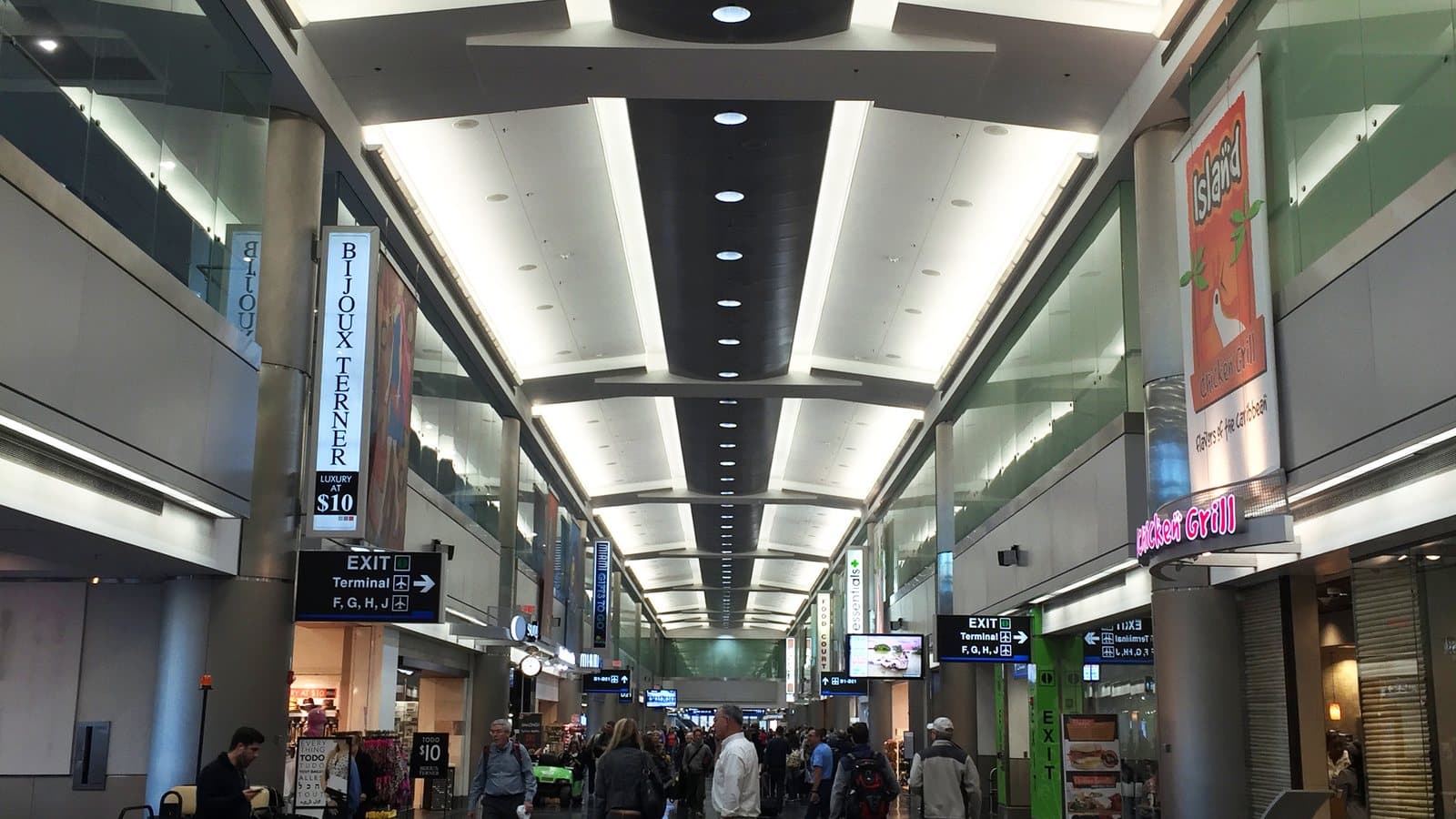
MIA is one U-shaped building split into three terminals and six concourses (D to J). Arrivals and baggage claim always sit on Level 1, departures and check-in on Level 2, and the walkways between concourses plus the MIA Mover on Level 3.
| Terminal | Concourses | Typical arrivals |
|---|---|---|
| North (Blue) | D | American Airlines, domestic and international |
| Central (Yellow) | E, F, G | American and Oneworld partners, Caribbean and Latin American carriers (E); domestic and Canadian services (F, G) |
| South (Red) | H, J | Delta and other non-Oneworld airlines (H); long-haul intercontinental routes (J) |
The airline directory shows which concourse each carrier uses, and the terminals guide explains the layout in full. The airport map is the quickest way to point someone at the right door.
Baggage claim, passport control and customs
Baggage claim is on Level 1 of the terminal your flight arrives at — you do not change buildings to collect a bag. Passengers arriving from outside the United States clear passport control and customs before they reach the public part of Level 1, which is why the gap between "landed" on the board and "walking out of the door" is longer on an international flight than on a domestic one. What that process involves is covered in our guide to immigration and customs at Miami Airport.
If a bag does not appear, the airline's baggage desk in the same hall handles the claim; what each carrier allows in the hold is listed in the baggage allowance guide.
Meeting someone: where to wait
- Same terminal as the flight. Level 1 of North, Central or South — not "the arrivals hall", because MIA has three of them.
- Watch the board, not the schedule. The board above shows the status the airport publishes; an early landing still means a wait for bags and, on international flights, for passport control.
- Kerbside is for pick-up, not parking. Short stays and garages are covered in our parking guide.
Onward travel from Level 1
MIA has no rail platform inside the terminals. The free MIA Mover, in the middle of the U between the Dolphin and Flamingo parking garages, runs from Level 3 to the Car Rental Center and the Miami Intermodal Center, about a mile (1.6 km) away. From there:
- Metrorail Orange Line: 05:00 to midnight, seven days a week, every 15 minutes, calling at Government Center, Brickell and other central stops. At weekends the line runs only as an airport shuttle between MIA and Earlington Heights, so a Saturday or Sunday trip into the city means a transfer to a Green Line train at Earlington Heights; the shuttle itself keeps the 15-minute frequency.
- Tri-Rail — the commuter line north through Broward and Palm Beach counties, and the rail link to Fort Lauderdale–Hollywood International Airport.
Fares, timetables and the alternatives are in our guides to trains from and to Miami Airport, airport taxis and getting to downtown Miami. Picking up a hire car? The rental centre is at the other end of the MIA Mover line.
Connecting on to another flight
Only Concourses D–E and H–J are linked behind security. Landing in one and departing from another concourse usually means leaving the secure area and clearing screening again, so treat a connection at MIA as a landside transfer unless it falls into those two pairs. The Level 3 links are a bridge near Gates D31 and E2 and a walkway near Gates G2 and H3. A $51 million sterile connector between Concourses F, G, H and J is due to start in autumn 2026 and is scheduled to take about two years and three months.
With a long gap, see whether leaving the airport during a layover works for your ticket, or wait in one of the airport lounges.